Shopify Ecommerce Trends 2026: 8 Shifts Reshaping Online Retail
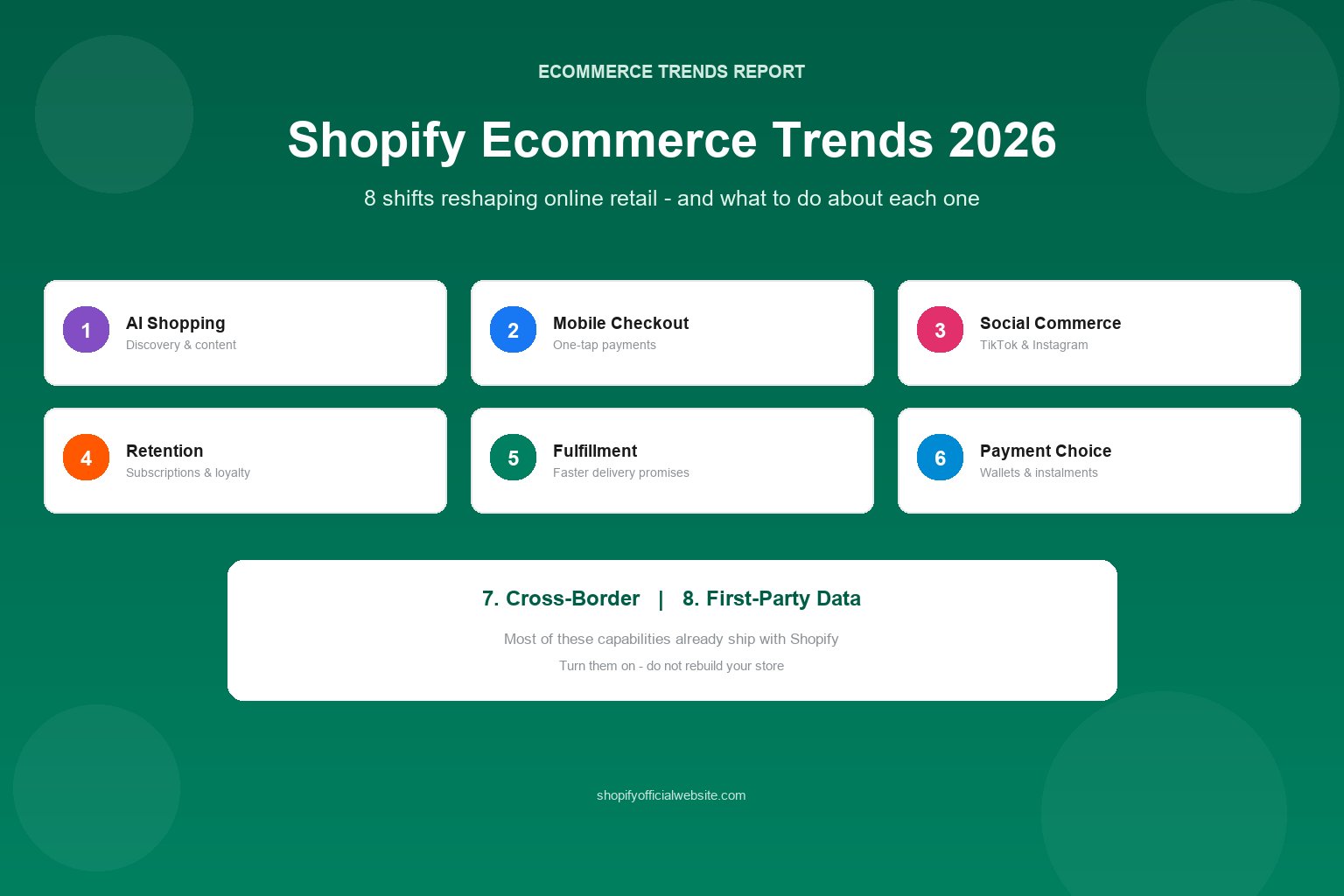
Table of Contents
- AI Shopping Becomes the Default Experience
- Mobile Checkout Is Now the Whole Funnel
- Social Commerce Becomes a Real Sales Channel
- Retention Overtakes Acquisition
- Fulfillment Speed Becomes a Marketing Claim
- Payment Choice Directly Drives Conversion
- Cross-Border Selling Enters the Mainstream
- First-Party Data Replaces Third-Party Tracking
- How to Prepare Your Store for 2026
Ecommerce never sits still, and 2026 is showing that more clearly than most years. Expectations that formed over the last few years have hardened into defaults: fast pages, one-tap checkout, delivery windows customers can trust, and product pages that answer questions before they are asked.
For Shopify merchants, this is good news. Most of the infrastructure behind these trends — AI tools, social channel integrations, Shop Pay, Shopify Markets, subscriptions — already ships with the platform or installs from the App Store. The work isn't building new systems; it's deciding which shifts matter for your store and switching them on.
Below are the eight trends reshaping online retail in 2026, what each one means in practical terms, and the specific moves worth making this quarter.
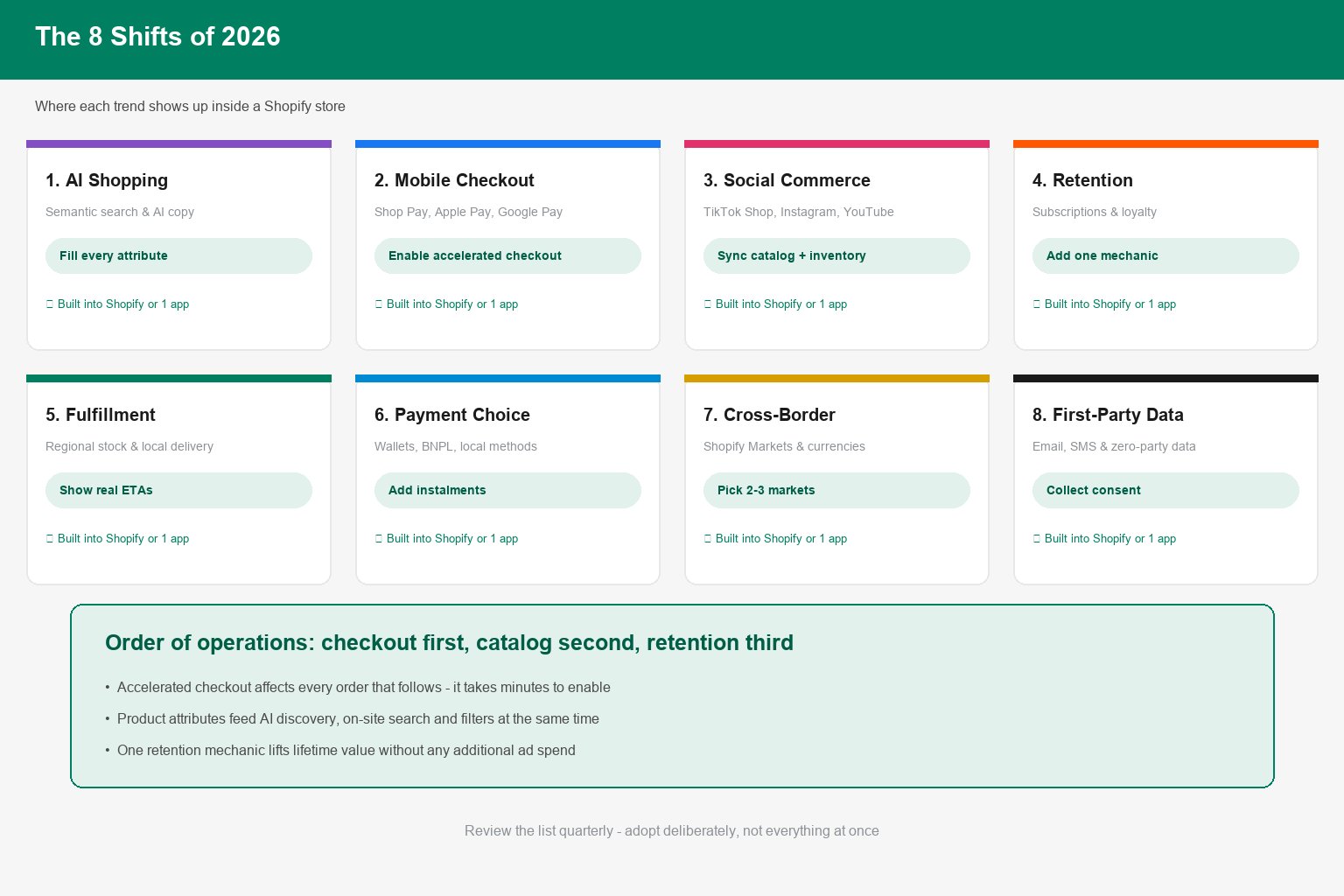
1. AI Shopping Becomes the Default Experience
AI stopped being a demo. In 2026 it shows up in three places that directly affect revenue: how shoppers find products, how fast you can produce content, and how much manual work your operations require.
Where AI is doing real work right now:
- Product discovery: Shoppers increasingly start with a conversational question rather than a keyword. Semantic search and AI shopping assistants match intent to products, which changes how your catalog needs to be written.
- Content generation: Shopify Magic writes product descriptions, translates them into other languages, and removes or replaces image backgrounds — hours of work per catalog compressed into minutes.
- Operational assistance: Sidekick answers questions in plain language, such as which products had the highest return rate last quarter, without you building a report.
- Automated merchandising: Recommendations and smart collections adapt to browsing behaviour instead of being curated by hand once a quarter.
The practical consequence is that catalog quality has become a ranking factor. Stores with thin titles, one-line descriptions, and missing attributes are the ones AI cannot surface, which is a competitive disadvantage that compounds every month.
2. Mobile Checkout Is Now the Whole Funnel
Mobile drives the majority of ecommerce traffic globally, yet mobile conversion still lags desktop on most stores. The gap is rarely about willingness to buy — it's about friction: typing a card number on a phone, forced account creation, and pages that take too long to load.
Shop Pay is the single highest-leverage fix available to a Shopify store. It stores payment and address details so a returning buyer completes checkout with a tap, and it consistently converts materially higher than a standard guest checkout.
- Turn on accelerated checkout: Shop Pay, Apple Pay and Google Pay.
- Allow guest checkout. Forcing account creation before payment is one of the most expensive habits in ecommerce.
- Cut form fields to the minimum your carrier and tax rules actually require.
- Compress images and audit apps. Every additional second of load time measurably reduces conversion.
One-tap checkout isn't a nice-to-have anymore. For a returning customer on a phone, a checkout that asks for a card number is a checkout that loses the sale.
3. Social Commerce Becomes a Real Sales Channel
Social platforms spent years trying to become storefronts. In 2026 they largely have. TikTok Shop, Instagram Shopping and YouTube Shopping let a customer discover, evaluate and buy without ever visiting your domain.
The strategic shift is that social is no longer only a top-of-funnel awareness channel with fuzzy attribution. It now has its own catalog, its own checkout and its own reporting — which means it needs its own product data and its own creative cadence.
Practical setup: connect your product catalog to each channel from the Shopify admin, keep inventory synced so you never oversell, and treat short-form video as a permanent content line item rather than a one-off campaign. We cover the channel-by-channel workflow in our multi-channel selling guide.
4. Retention Overtakes Acquisition
Paid acquisition costs have risen steadily for years, and attribution has only gotten noisier. The response from profitable stores in 2026 has been to shift budget toward keeping the customers they already have.
- Subscriptions: Consumables, refills and curated boxes turn a one-time buyer into recurring revenue. Shopify Subscriptions is built in — no app required to start.
- Loyalty programs: Points, tiers and referrals give repeat buyers a reason to consolidate their spending with you instead of a competitor.
- Post-purchase flows: Reorder reminders timed to actual consumption cycles outperform generic win-back campaigns.
- Bundles and kits: Raising average order value at the first purchase shortens the payback period on every acquisition dollar.
If you only measure cost per acquisition, you are optimizing half the business. Track repeat purchase rate and 90-day customer lifetime value alongside it — our guide to driving traffic covers the acquisition half of the equation.
5. Fulfillment Speed Becomes a Marketing Claim
Delivery expectations have compressed to the point where speed belongs on the product page. Two-day delivery used to be a premium differentiator; in many categories it is now table stakes, and same-day local delivery is the new premium.
- Display delivery estimates at checkout. Uncertainty is a bigger conversion killer than a slower date — a precise promise beats a vague one.
- Split inventory across regions so the nearest warehouse ships, cutting both cost and transit time.
- Offer local pickup or local delivery for dense metro areas where you already have demand.
- Automate label buying and tracking so dispatch never becomes a manual bottleneck during a sales spike.
A precise delivery date converts better than a fast one. “Arrives Tuesday, October 14” outperforms “ships fast” on almost every store that has tested it.
6. Payment Choice Directly Drives Conversion
Checkout abandonment remains the largest single leak in ecommerce. A meaningful share of it isn't hesitation — it's the customer's preferred payment method simply not being offered.
Shopify Payments supports cards, wallets and local methods across more than 130 countries and currencies, and Shop Pay Installments lets buyers split a purchase without leaving checkout. Adding these options isn't a redesign; it's a settings change. See our Shopify Payments setup guide for the exact steps.
- Offer at least one instalment option for orders above your average order value.
- Enable local payment methods for your top cross-border markets — iDEAL, Klarna, Alipay and similar.
- Show the total in the buyer's currency from the product page onward, not only at checkout.
- Keep checkout steps to a minimum. Every extra screen is another chance to lose the order.
7. Cross-Border Selling Enters the Mainstream
Selling internationally used to require separate stores, separate inventory and a developer. Shopify Markets consolidates that into one admin: multiple currencies, localized domains or subfolders, translated content and market-specific pricing.
The trend in 2026 isn't that merchants are going global — it's that they're doing it selectively, using their own data to pick two or three markets rather than shipping everywhere at once and hoping.
- Start with markets already in your analytics. You have demand signals before you spend a cent on localization.
- Localize currency, language and payment methods. Leave everything else standard until volume justifies it.
- Collect duties and taxes at checkout so customers aren't surprised by a bill at the door.
- Verify carrier coverage before you advertise a delivery promise you can't keep.
8. First-Party Data Replaces Third-Party Tracking
Third-party cookies continue to erode and privacy rules keep expanding. The stores growing predictably in 2026 are the ones collecting first-party data on purpose: email subscribers, SMS consent, quiz answers and purchase history.
- Collect consent at several points — popup, footer, post-purchase and account creation.
- Use zero-party data. Quizzes and preference centres let you personalize without tracking anyone.
- Segment by behaviour, not demographics: what someone browsed, bought and abandoned says far more than their age bracket.
- Keep your data exportable. Lists, reviews and loyalty balances are business assets, not app lock-in.
How to Prepare Your Store for 2026
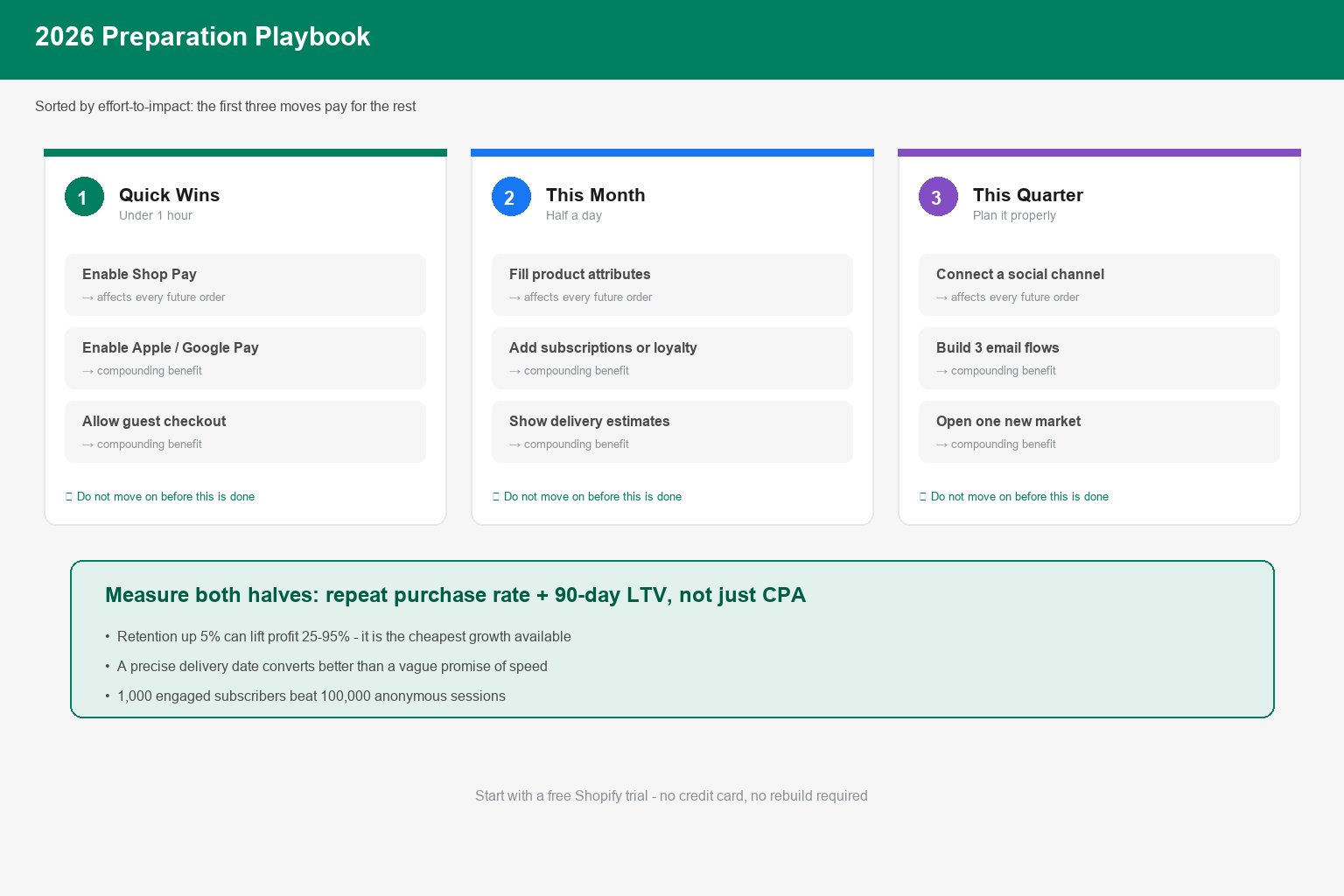
You don't need to act on all eight trends this quarter. Use this order of operations — it's sorted by effort-to-impact ratio, so the first three moves effectively pay for the rest.
- Turn on accelerated checkout. Shop Pay, Apple Pay and Google Pay take minutes to enable and affect every order that follows.
- Fill out your product attributes. Material, fit, dimensions, compatibility, use case — this feeds AI discovery, search and on-site filters.
- Add one retention mechanic. Subscriptions for consumables, a loyalty program for everything else.
- Show real delivery estimates on the product page and at checkout.
- Connect one social sales channel — the platform where your buyers already spend time.
- Set up your first three email flows: welcome, abandoned cart and post-purchase.
- Review one new market per quarter, using existing analytics rather than guesswork.
None of these trends require you to rebuild your store — that's the advantage of running on a platform where the underlying capability already exists. Start a free trial, work down the list, and revisit it quarterly. The stores that win in 2026 won't be the ones that adopted everything first; they'll be the ones that adopted the right things deliberately.
Start Building Your Store Today
Launch on Shopify and switch on the features behind every 2026 trend. 3 days free, no credit card required.
Start Free Trial Now