Shopify Multi-Channel Selling: Complete Guide to Sell Everywhere in 2026
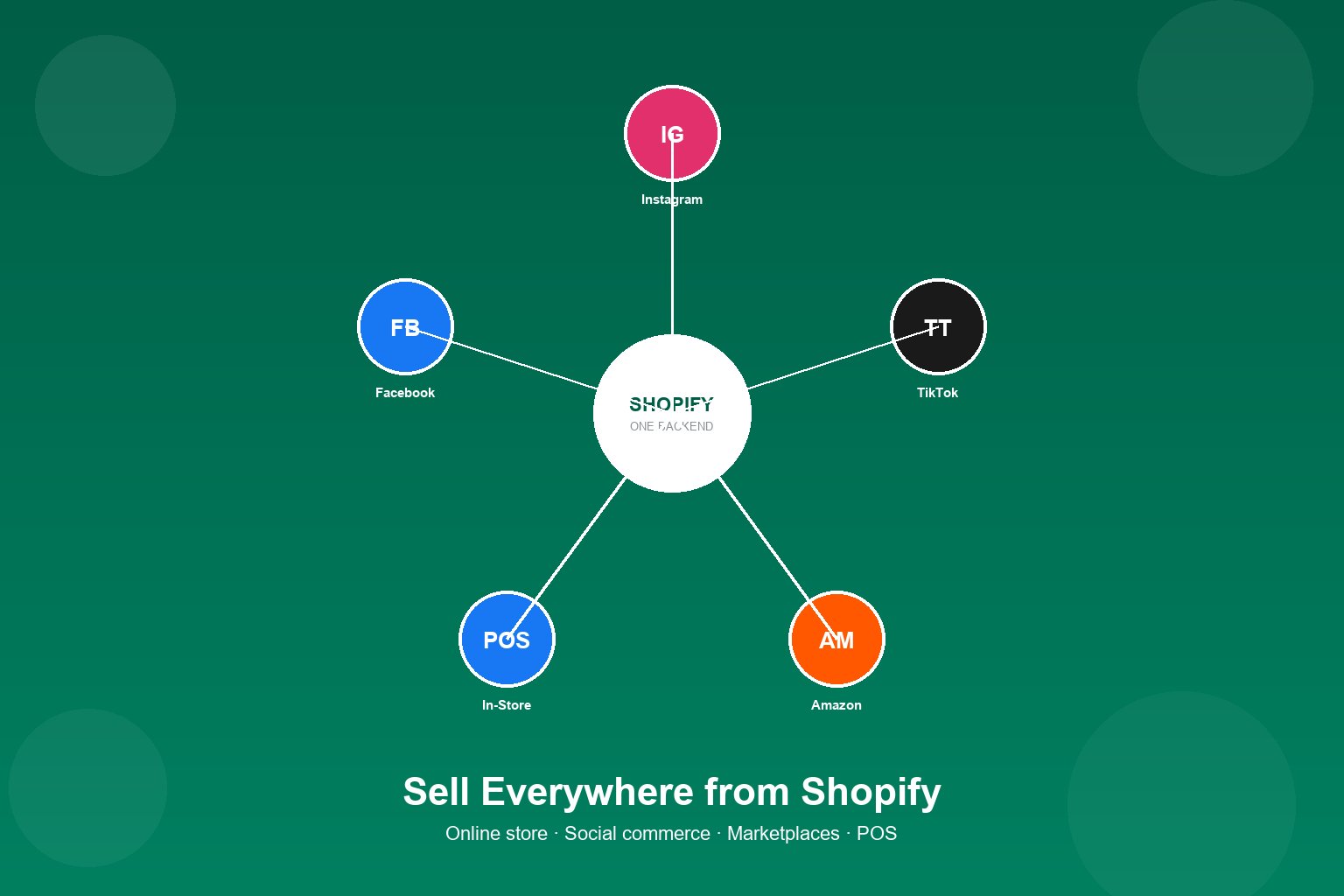
Table of Contents
- Why Multi-Channel Selling Matters in 2026
- How Shopify Unifies Your Sales Channels
- Selling on Social Media: Instagram, TikTok & Facebook
- Selling on Marketplaces: Amazon, eBay & Etsy
- Selling In-Store with Shopify POS
- Centralized Inventory Management Across Channels
- Automating Your Multi-Channel Workflows
- Measuring Multi-Channel Performance
The smartest Shopify merchants in 2026 don't rely on a single sales channel. They meet customers wherever they shop — Instagram, TikTok, Amazon, Google, their own online store, and even physical retail locations — all from a single Shopify dashboard.
Multi-channel selling isn't just a growth tactic anymore. It's the baseline expectation. Shoppers now discover products on social media, compare prices on Amazon, and pick up in-store — sometimes completing all three for a single purchase. In this guide, you'll learn exactly how to set up, manage, and scale a multi-channel Shopify store that turns every channel into a high-converting storefront.
Why Multi-Channel Selling Matters in 2026
Customer behavior has fundamentally shifted. The average shopper now uses 6+ touchpoints before making a purchase — and they expect a consistent brand experience across all of them. A single-channel store is leaving serious revenue on the table.
Here are the numbers that make multi-channel selling non-negotiable in 2026:
- Multi-channel shoppers spend 3x more: Customers who buy from multiple channels have a 30% higher lifetime value than single-channel buyers (Harvard Business Review).
- Social commerce is exploding: TikTok Shop, Instagram Shopping, and Facebook Shops now drive over $1.2 trillion in global sales annually.
- Marketplace dominance: 56% of online shoppers start their product search on Amazon — even when they end up buying elsewhere.
- Buy Online, Pick Up In-Store (BOPIS): 73% of consumers use BOPIS, and it converts at 2x the rate of standard online checkout.
- Lower acquisition costs: Selling on existing platforms (Amazon, TikTok) is significantly cheaper than driving cold traffic to your own site.
Shopify makes this possible without the technical complexity. Instead of running separate platforms with separate inventories, separate order systems, and separate analytics, you manage everything from one place.
How Shopify Unifies Your Sales Channels
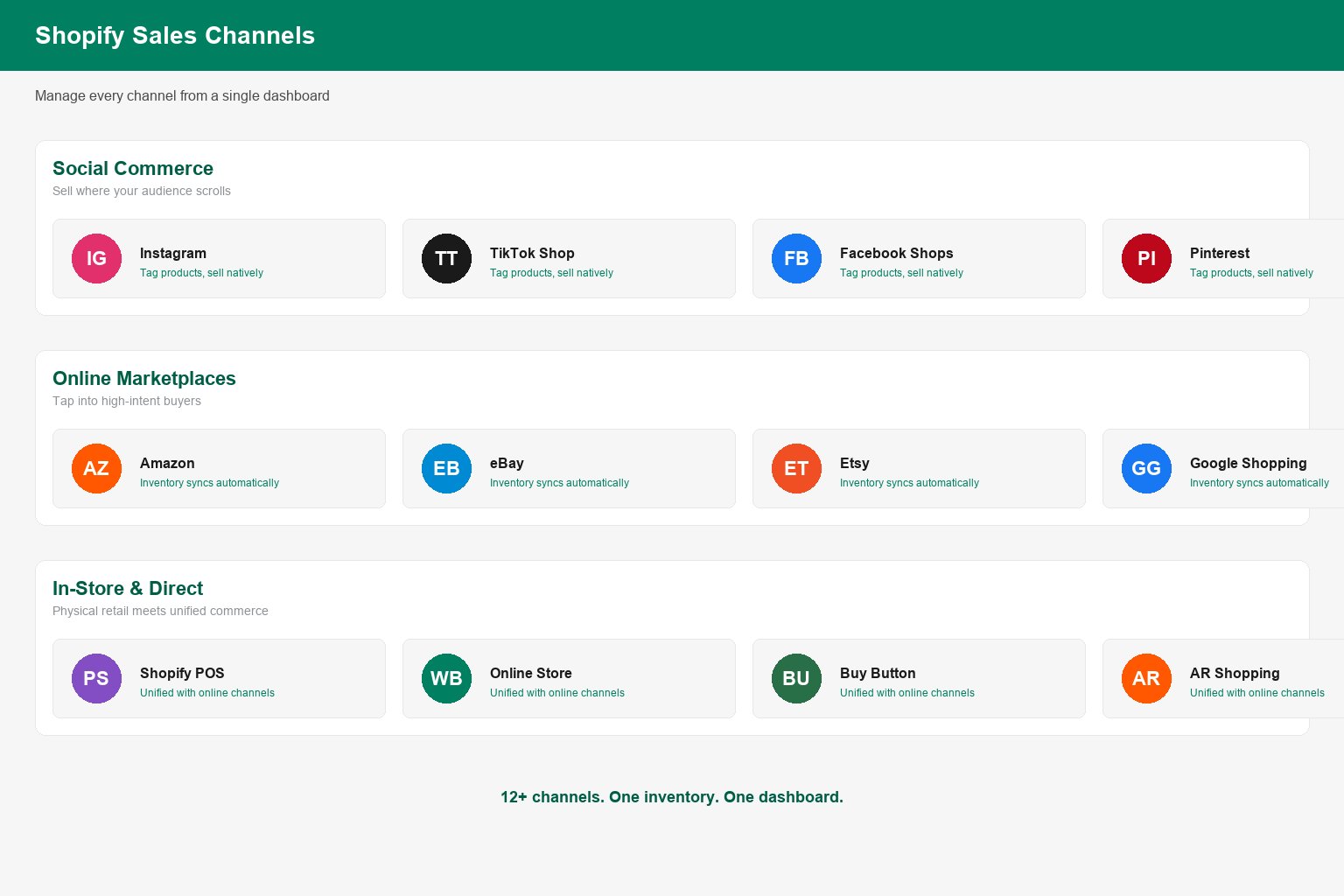
Shopify's biggest competitive advantage in multi-channel selling is its unified backend. Once you add a product to your Shopify store, you can publish it to any connected channel in a few clicks — and inventory, orders, and customer data stay in sync automatically.
What Shopify unifies across all channels:
- Product catalog: Add a product once, publish it everywhere. Product descriptions, images, variants, and pricing stay in sync.
- Inventory levels: When a product sells on Instagram, the stock count automatically updates on Amazon, your website, and in-store. No more overselling.
- Order management: All orders from every channel appear in your Shopify admin. Fulfill, refund, and track them from one screen.
- Customer profiles: Every customer — regardless of where they bought — gets a unified profile with full purchase history.
- Analytics & reporting: See which channels drive the most revenue, profit, and customer lifetime value without switching tools.
- Discounts & gift cards: Run a single promotion and apply it across all channels simultaneously.
- Tax & shipping settings: Configure once, apply everywhere — no per-channel tax setup headaches.
This unified approach saves merchants an average of 18 hours per week compared to running separate platforms (according to Shopify's 2025 merchant survey).
Selling on Social Media: Instagram, TikTok & Facebook
Social commerce is no longer optional. If your customers are scrolling Instagram or TikTok, you need to be there with a frictionless way to buy. Shopify's native integrations with Meta and TikTok make this surprisingly simple.
1. Instagram Shopping & Facebook Shops
Shopify is an official Meta partner, so connecting your store to Instagram Shopping and Facebook Shops is built into the platform — no third-party apps required.
- Tag products in posts and Reels: Turn any organic post into a shoppable moment.
- Instagram Shop tab: Your full product catalog appears inside the Instagram app.
- Live shopping: Sell in real-time during Instagram Live broadcasts.
- Checkout on Instagram: Customers can complete purchase without leaving the app (US merchants).
- Facebook Shops: Same catalog, additional reach on Facebook's audience.
2. TikTok Shop
TikTok Shop has exploded in 2025–2026, and Shopify merchants have a direct integration. You can tag products in TikTok videos, run TikTok Shop ads, and let creators sell your products through the TikTok affiliate marketplace.
- Shoppable videos: Tag your products in any TikTok video with a few clicks.
- TikTok Shop tab: Customers browse and buy inside TikTok.
- Creator partnerships: The TikTok Shop creator marketplace connects you with influencers who'll promote your products for commission.
- LIVE shopping: Run live selling events directly from TikTok.
3. Pinterest & YouTube Shopping
Shopify also supports Product Pins on Pinterest and shoppable YouTube videos, giving you access to high-intent audiences on visual and video-first platforms.
Selling on Marketplaces: Amazon, eBay & Etsy
Marketplaces are search engines for shoppers ready to buy. Unlike social media, marketplace visitors have high purchase intent — they're already searching for products. Shopify's marketplace integrations let you tap into that demand without leaving the Shopify dashboard.
1. Amazon Integration
Shopify's Amazon channel (powered by the official Amazon Sales Channel app) lets you list products on Amazon and manage everything from Shopify. Key features:
- List products from your Shopify catalog to Amazon in bulk
- Automatic inventory sync (no overselling across channels)
- Amazon FBA integration — ship to Amazon's warehouse, let them handle fulfillment
- Amazon Prime badge eligibility (huge conversion boost)
- Manage Amazon orders directly from Shopify admin
2. eBay Integration
For merchants selling collectibles, used items, refurbished goods, or unique inventory, eBay remains a powerful channel. Shopify's eBay integration handles listings, inventory sync, and order management automatically.
3. Etsy Integration
Handmade, vintage, and craft-focused merchants can use Shopify's Etsy integration to manage their Etsy shop alongside their main store. The integration is especially valuable for sellers who started on Etsy but want to scale to a branded Shopify store.
4. Google Shopping & YouTube
Shopify's Google channel connects your product feed to Google Merchant Center, making your products eligible for free Google Shopping listings, Google Search results, and YouTube Shopping. This is the easiest way to appear when customers search for products you sell.
Key insight: Marketplace traffic converts 2-3x higher than cold social media traffic because shoppers arrive with purchase intent already. Use marketplaces for volume, your own site for margin and brand building.
Selling In-Store with Shopify POS
Physical retail isn't dead — it's evolving. Shopify POS (Point of Sale) is the bridge between your online store and your brick-and-mortar locations, with a single inventory, single customer database, and unified reporting.
What Shopify POS gives you:
- Unified inventory: Sell in-store and online from the same stock pool. No more separate warehouse management.
- Customer profiles sync: In-store customers get added to your Shopify CRM. Email them, retarget them, track lifetime value.
- Buy Online, Pick Up In-Store (BOPIS): Customers order online, pick up at your store. Shopify handles the workflow.
- Endless aisle: If a product is out of stock in-store, your staff can order it for the customer from the online catalog — without leaving the POS.
- Mobile POS: Take card payments anywhere in the store with a phone or tablet. No checkout line required.
- Hardware compatibility: Shopify POS works with most receipt printers, barcode scanners, and cash drawers.
- Tap to pay: iPhone and Android tap-to-pay support — no extra hardware needed.
Shopify POS is free to install, and you only pay per-location hardware fees. For pop-up shops, markets, and small retail setups, the cost is minimal.
Centralized Inventory Management Across Channels
The single biggest challenge of multi-channel selling is inventory. Sell on too many channels without proper sync and you oversell — promising customers a product that's already gone. Shopify's inventory management solves this elegantly.
How Shopify handles multi-location, multi-channel inventory:
- Single source of truth: One inventory count per product, automatically updated when sales happen anywhere.
- Multi-location support: Track stock at warehouses, retail stores, and 3PLs separately. Set rules for which location fulfills which channel.
- Inventory forecasting: Shopify predicts when you'll run out of stock based on sales velocity and lead times.
- Low-stock alerts: Get notified before products go out of stock, so you can reorder or pause ads.
- Transfers between locations: Move stock between warehouses and stores with a few clicks.
- 3PL integration: Connect with third-party logistics providers (ShipBob, ShipHero, etc.) for outsourced fulfillment.
Inventory allocation strategy for multi-channel:
You don't have to make all your stock available on every channel. Shopify lets you allocate inventory per channel and per location:
- Reserve stock for high-margin channels: Keep your most profitable products on your own site, use marketplaces for volume.
- Prioritize locations by speed: If your East Coast warehouse is closer to most of your Amazon customers, route those orders there.
- Use safety stock: Always keep 10–20% of inventory in reserve to prevent stockouts on viral content or unexpected demand spikes.
Automating Your Multi-Channel Workflows
Managing multiple sales channels manually is a recipe for burnout. Shopify's automation tools (Shopify Flow, plus hundreds of apps) handle the repetitive work so you can focus on strategy and growth.
1. Shopify Flow (built-in, free on Advanced and Shopify plans)
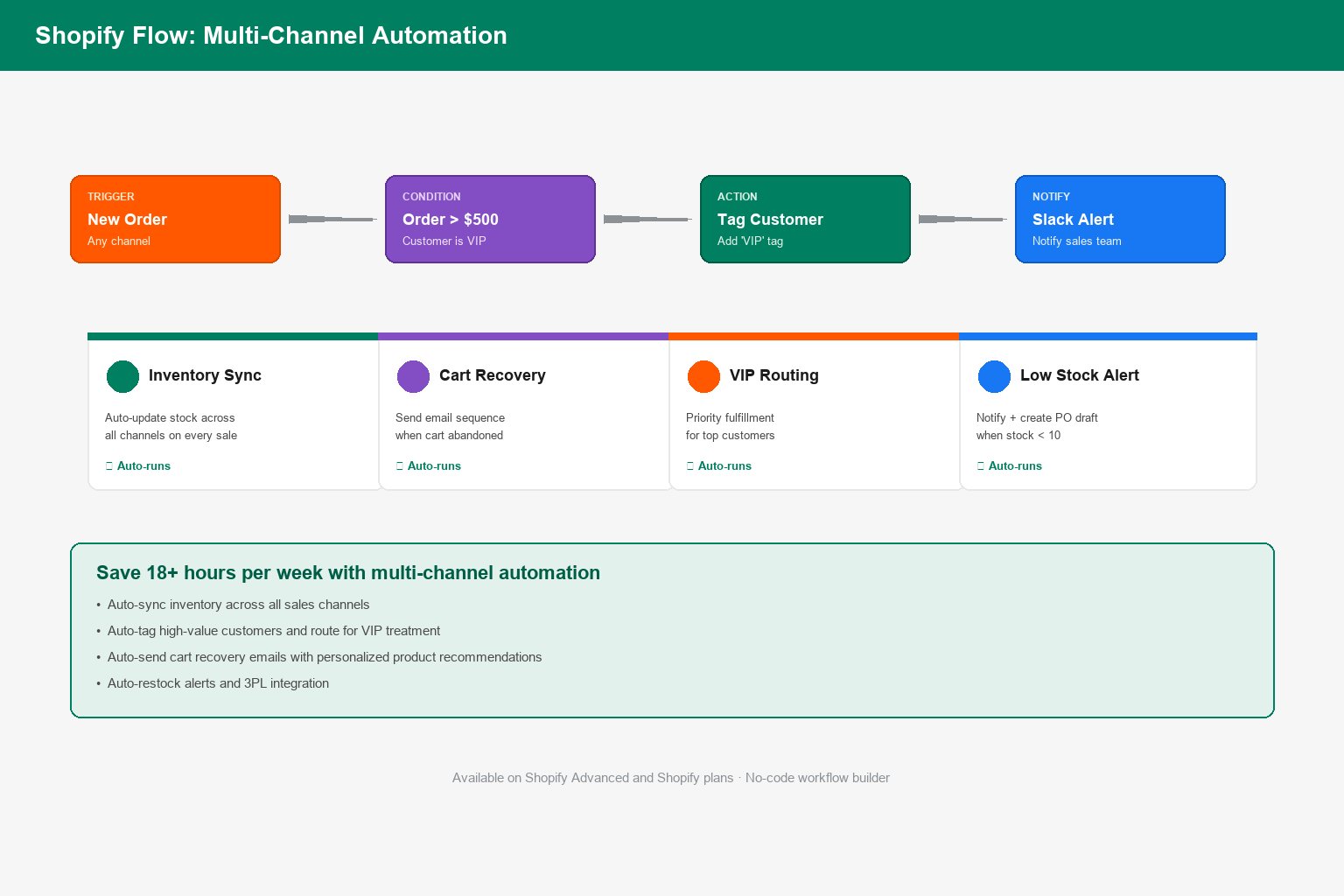
Shopify Flow is a no-code automation builder. Create workflows that respond to triggers across your channels:
- Auto-tagging high-value customers: Tag any customer who spends over $500 with "VIP" and notify your team on Slack.
- Restock alerts: When inventory drops below 10 units, send a Slack notification and create a purchase order draft.
- Cross-channel restocking: When a product is out of stock on one channel, automatically hide it on all other channels.
- VIP routing: Orders from repeat customers get auto-routed to a different fulfillment queue for priority processing.
- Fraud monitoring: Flag high-risk orders across channels for manual review before fulfillment.
2. Marketing automation across channels
- Abandoned cart recovery: Send a cart abandonment email regardless of which channel the customer came from.
- Post-purchase sequences: Trigger a thank-you + cross-sell email after any purchase — Instagram, Amazon, or your own site.
- Win-back campaigns: Automatically email customers who haven't purchased in 90 days with a tailored offer.
- Review requests: Send review request emails 7 days after delivery, regardless of the original sales channel.
3. Order routing and fulfillment automation
- Auto-route by location: Ship from the warehouse closest to the customer, regardless of which channel they ordered from.
- Auto-select carrier: Use the cheapest carrier for each order based on weight, destination, and delivery speed.
- Auto-split orders: If items in one order ship from different locations, Shopify automatically splits and routes them.
Measuring Multi-Channel Performance
Without proper measurement, multi-channel selling is just a guessing game. Shopify's analytics — plus a few external tools — give you complete visibility into which channels drive revenue, profit, and customer lifetime value.
1. Built-in Shopify reports
Shopify's reports section includes multi-channel dashboards out of the box:
- Sales by channel: See revenue contribution from each channel (online store, POS, social, marketplaces).
- Customer acquisition source: Track which channels bring new vs. returning customers.
- Average order value by channel: AOV differs wildly between Instagram and Amazon — track both.
- Profit by channel: After accounting for fees, returns, and ad spend, which channel is most profitable?
- Inventory turnover: How quickly products sell across all channels combined.
2. Key multi-channel metrics to track
- Channel contribution margin: Revenue minus channel-specific costs (Amazon fees, Instagram ad spend, etc.)
- Cross-channel customer rate: What % of customers buy from 2+ channels? These are your highest-LTV customers.
- Channel-specific conversion rate: How well does each channel convert traffic to sales?
- Return rate by channel: Some channels (Instagram) have higher return rates than others (your own site).
- Stockout frequency by channel: If you keep running out of stock on Amazon, you need a better inventory allocation strategy.
3. Attribution modeling
Multi-channel attribution is hard. A customer might discover you on TikTok, research on Google, and finally buy on your own site. Which channel gets the credit? Shopify's attribution model gives credit to the last touchpoint by default, but you can switch to first-click or data-driven models in the analytics settings.
Warning: Don't optimize for the wrong metric. A channel with lower conversion but higher AOV might be more profitable than a high-traffic, low-AOV channel. Always look at contribution margin, not raw revenue.
For more on building a complete sales strategy, read our guide on driving traffic to your Shopify store, which covers paid ads, content marketing, and SEO alongside the multi-channel approach covered here.
Sell Everywhere with Shopify
Manage your online store, social channels, marketplaces, and POS from one dashboard. 3 days free, no credit card required.
Start Free Trial Now